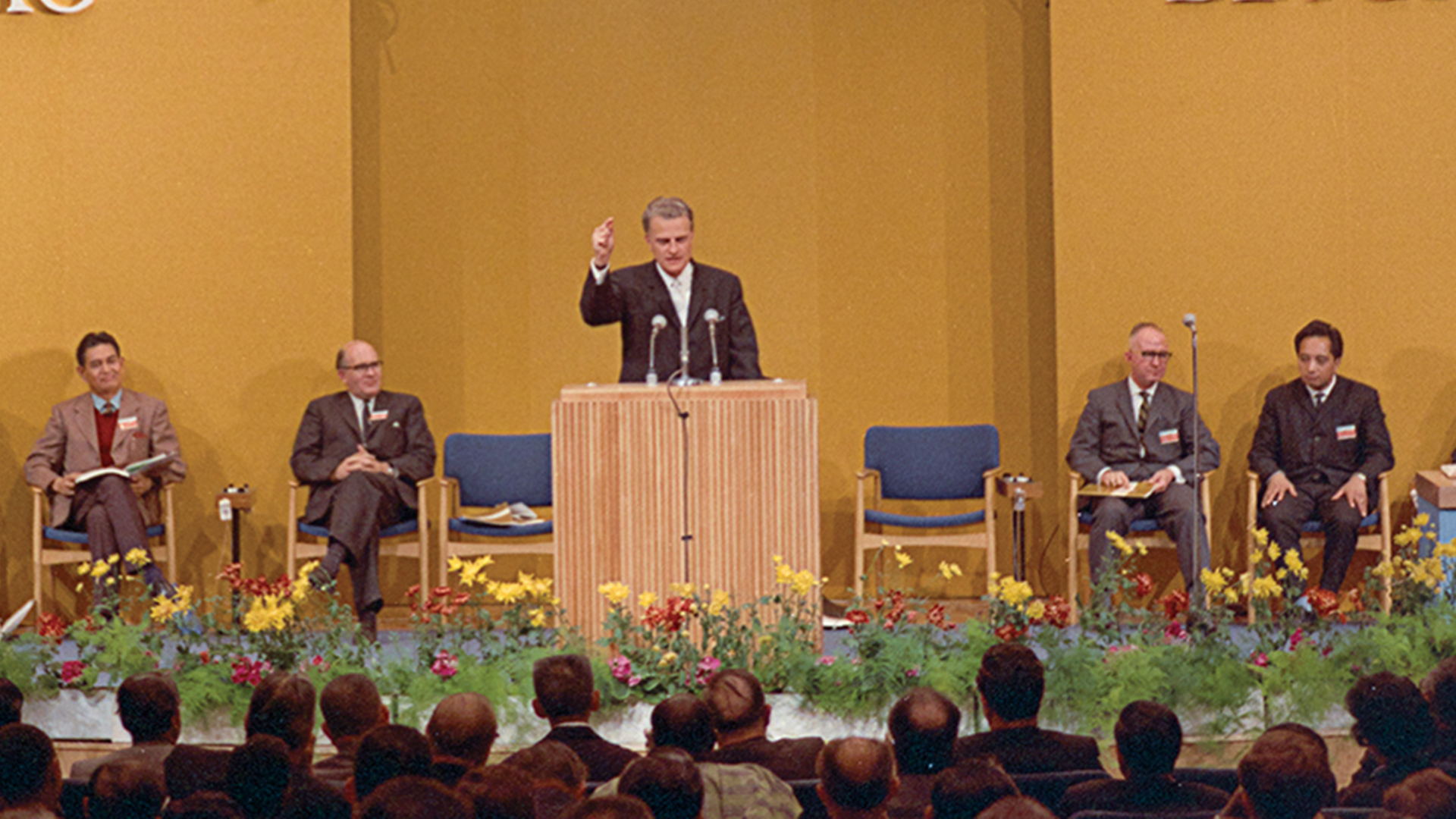
A quarter century after Billy Graham convened the Amsterdam 2000 gathering, which helped prepare more than 10,000 Christian leaders for the task of global evangelism, the Billy Graham Evangelistic Association is convening another milestone gathering of evangelicals for the purpose of spurring Gospel advancement.
The European Congress on Evangelism will be held May 27-30 in Berlin, Germany, where the first World Congress on Evangelism met in 1966 under the guidance of Billy Graham, Carl F.H. Henry and other leading evangelicals of the day.
This year’s meeting will draw more than a thousand Christian pastors and ministry leaders from 55 European countries and territories. Simultaneously, each message will be interpreted in nine languages, all with an aim “to encourage believers to reignite the church with a passion for proclamation evangelism,” said Viktor Hamm, BGEA’s vice president of Crusades.
Over four days, participants will hear from 20 speakers in numerous plenary sessions, Bible studies and addresses. The messages will center around one theme: Romans 1:16—“I am not ashamed of the gospel, for it is the power of God for salvation to everyone who believes, to the Jew first and also to the Greek” (ESV).
In a world of 8 billion people, the task of evangelizing the lost in this generation is more urgent than ever.
Billy Graham articulated this challenge in 1966 when he wrote, “Today, if the Christian Church could be aflame with enthusiasm for the Gospel of Christ, with the spirit of burning devotion to the Person of Christ, and with an overwhelming passion for the multitudes still outside Christ, we could change the world.”
That charge still holds.
“Proclaiming the Good News of Jesus Christ is still the greatest need in the world today, and it’s an honor for BGEA to once again come alongside and support the believers in Europe who are doing this important work,” Franklin Graham said in a statement.
A Rich History
During that first World Congress on Evangelism in 1966, the meeting was held in West Berlin when the city was still divided by the Berlin Wall—Communist East Germany and free West Germany. The roots of these international gatherings aimed at advancing the evangelistic task date back to at least 1960, when Billy Graham and 32 other like-minded Christian leaders from 12 countries met in Montreux, Switzerland.
At the time, an official with the ecumenical World Council of Churches (WCC), which had long fallen prey to liberal theology, had admitted to Mr. Graham and others that if the WCC were to adopt a definition of evangelism, it would split the group because of theological differences. Some others, Mr. Graham wrote, were even questioning whether individual salvation was necessary.
So in 1966 at the World Congress on Evangelism, Mr. Graham was clear: “At a time when the harvest is the ripest in history, the church is floundering in tragic confusion. … Evangelism means bearing witness, with the soul aflame, with the objective of winning men to a saving knowledge of the Lord Jesus Christ.”
The 1966 Berlin meeting led to other regional gatherings, including a European Congress on Evangelism in Amsterdam in 1971. Then came Lausanne, Switzerland, in 1974; Amsterdam in 1983 and 1986; a North America gathering in Louisville, Kentucky, in 1994; then Amsterdam again in 2000. With each meeting, there were clear calls to carry on the task of world evangelism rooted in a robust Biblical theology and mandate.
As Franklin has noted, there is only one message that has the power to change lives, and it is that message that must be proclaimed with a new urgency in a new generation.