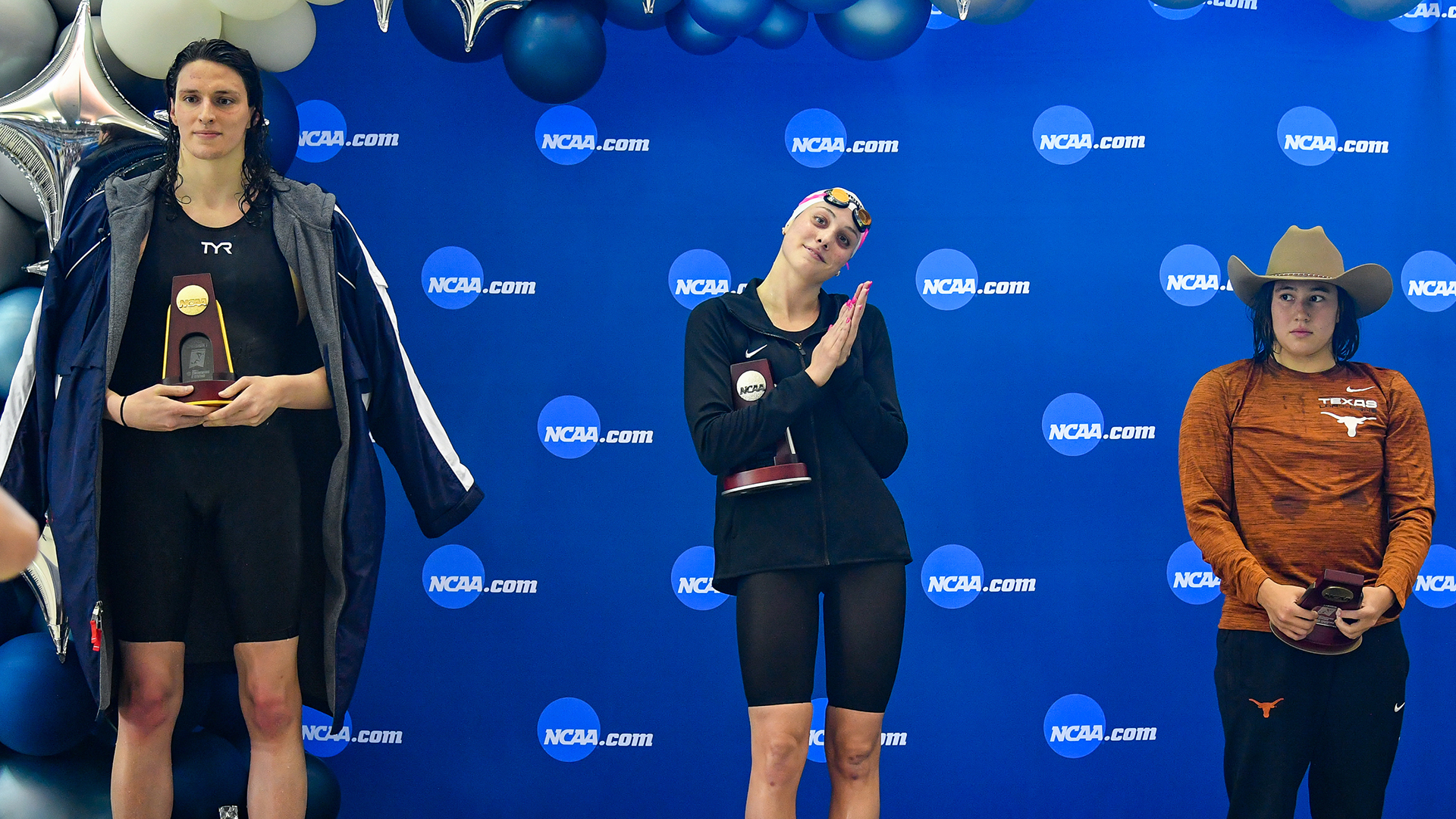
equal opportunity in athletic competition. And in late July, the United States Olympic & Paralympic Committee banned male athletes from competing in women’s sports, yielding to President Donald Trump’s executive order “Keeping Men Out of Women’s Sports,” which was issued in February.
Better late than never. Since 2008, SheWon.org has chronicled 2,242 female athletes losing out on 3,126 medals to males in 1,311 competitions in 46 sports. At press time, the website had tallied almost 900 first-place finishes in women’s competitions that have been stolen by males who identify as transgender females.
From 2017 through 2019, two Connecticut male athletes who identified as female took 15 women’s high school state championship titles that were previously held by nine different girls.
In 2020, Alliance Defending Freedom (ADF) helped the Idaho state legislature pass the Fairness in Women’s Sports Act into law, the first such legislation of its kind to protect equal opportunities for girls and women.
Shortly after the law’s passage, the ACLU filed a lawsuit to block its enforcement on behalf of Lindsay Hecox, a transgender woman who wanted to try out for the Boise State University women’s track and cross-country teams.Then two female track athletes at Idaho State University, Madison Kenyon and Mary Kate Marshall, asked ADF lawyers to intervene after a male athlete from the University of Montana crushed the competition and took first place in the women’s mile at the 2020 NCAA Division I Big Sky Conference Championships.
Following unfavorable rulings in federal court and the U.S. Court of Appeals for the 9th Circuit against Idaho’s fairness law to keep men out of women’s athletic competition, ADF attorneys and the Idaho attorney general petitioned the U.S. Supreme Court to review the lower court rulings.
In its petition for review by the Supreme Court of Little v. Hecox, the state told the justices that its law was intended to ensure that “women and girls are not forced to compete against men and boys who benefit from the ‘enduring physical differences between men and women.’” It urged the court to grant review and “decide whether the Constitution prohibits the people’s elected representatives in half the states from relying on sex-based distinctions to save women’s sports.”
Jonathan Scruggs, vice president of ADF’s litigation strategies and Center for Conscience Initiatives, said he’s optimistic that the high court will reverse the lower courts’ rulings.
“There’s a reason we designate sports by sex—because it would be unfair to women and girls if we didn’t,” Scruggs said. “And that’s something that people in America have acknowledged for the longest time. It’s why Title IX was passed. Title IX was passed in order to provide more equal opportunities for women and girls. And Title IX allows for sex designation of sports. So I think those are really two huge reasons for optimism.”
A similar case, State of West Virginia v. B.P.J., centers around a 14-year-old transgender athlete who has publicly identified as a girl since the third grade. B.P.J., a biological male, takes puberty blockers while also receiving hormone therapy with estrogen.
Themiddle-school male student has competed on a West Virginia girls’ track team, finishing ahead of almost 300 girls in three years in cross-country and track-and-field events. The state’s attorney general and ADF attorneys intervened in a lawsuit to defend the state’s law, which was enacted to ensure equal athletic opportunities for women.
Rena Lindevaldsen, professor of law at the Liberty University School of Law, told Decision thatthe Supreme Court’s 6-3 ruling in mid-June to uphold Tennessee’s ban on transgender procedures for minors in United States v. Skrmetti, should bode well for protecting female athletic competition from male inclusion in the Idaho and West Virginia cases.
She cited concurring opinions written by justices Amy Coney Barrett and Samuel Alito—that transgender status has never been nor should ever be a protected class of people.
“I would like to think that the court, if it is consistent with Skrmetti, is going to say that just because we said men can’t play on female sports teams, that is not sex stereotyping because men and women are biologically different,” Lindevaldsen asserted. “And there are legitimate reasons for saying so, for women’s protection, for safety, for competitiveness, so they need to be in separate sports.”
In an era where presidential executive orders can sway the interpretation of laws—for better or worse—Lindevaldsen said Supreme Court rulings are essential for tempering the political whims from one administration to the next.
“I think it’s really important for the Supreme Court to have taken these cases,” she said. “Because despite any change in political office, we will get a decision on how to interpret the equal protection clause, what Title IX means and how to apply it to this issue. That will go beyond whoever’s in the office next time.” ©2025 BGEA
Photo above: Biological male Lia Thomas, left, towers over second- and third-place finishers Emma Weyant and Erica Sullivan winning the 2022 NCAA championship in the women's 500 Freestyle.