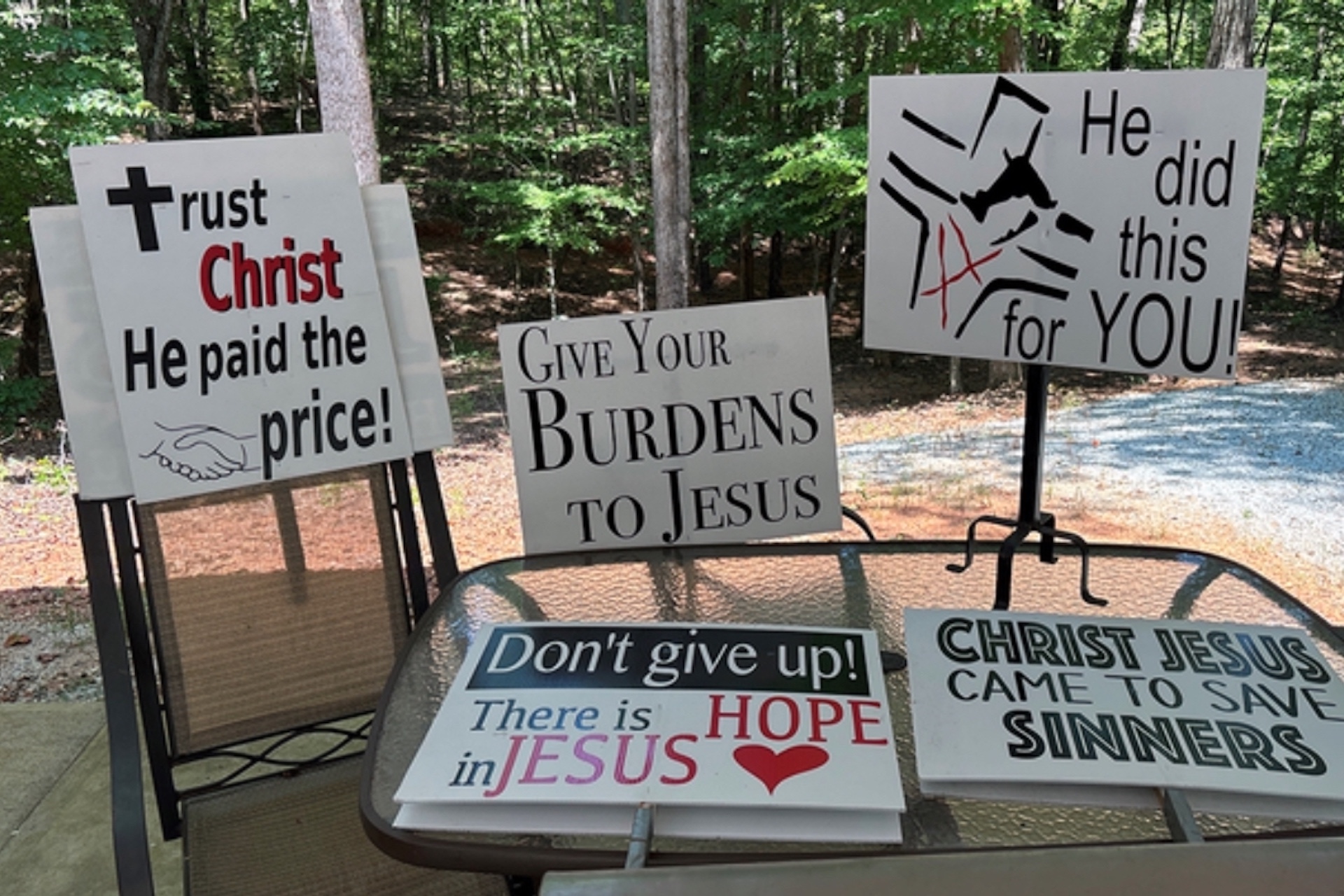
A South Carolina man can now hold religious signs in public following a ruling by the U.S. District Court for the District of South Carolina.
The court ruled that an ordinance by the town of Chapin requiring residents to obtain a permit before holding up signs and sharing their faith is unconstitutional.
The issue arose in June 2024, when Chapin resident Ernest Giardino held up a 20- by 24-inch sign with the words “Trust Christ He paid the price” on one side and “He Saved Others—Jesus—He’ll Save You” on the other. He had held similar signs on Chapin sidewalks for the previous eight months. But on June 20, as he was about to leave his spot at the intersection of Old Lexington Road and Chapin Road, a police officer approached him and said he needed permission from the town before he could hold such signs.
Confused, Giardino followed up in person with the town’s code enforcement officer and chief of police the following day. Both men confirmed that Giardino needed a permit.
The permit application required a two-week advanced notice for displaying signs in public places, and said residents could only hold a sign for 30 minutes, and were required to change sidewalk corners every 15 minutes.
Convinced that the town was infringing on his fundamental rights, Giardino took his concerns to First Liberty Institute, a religious liberty law firm, which then sent a demand letter to the town of Chapin.
“Mr. Giardino wants to share his religious beliefs through signs,” the letter read. “… Religious expression holds a place at the core of the type of speech the First Amendment was designed to protect.”
Signs, in particular, garner constitutional safeguarding, First Liberty said, even if others happen to find the signs offensive.
“Permit schemes, like the one found in Chapin, have the effect of freezing speech before it is uttered,” the letter continued. “Permit schemes are thus viewed skeptically, being ‘the most serious and least tolerable infringement on First Amendment rights.’”
No one should be forced to ask the government’s permission to express their faith in a public square, said First Liberty Counsel Nate Kellum. “The First Amendment is his permit. Like any citizen in any city in America, Mr. Giardino is free to peacefully share his religious beliefs on a public sidewalk.”
The demand letter asked the town to respond by Nov. 12, 2024, with written assurance that Chapin would no longer ban Giardino’s free expression on public sidewalks through permit requirements.
The town did not respond, and in July First Liberty filed suit on behalf of Giardino. The district court’s ruling on Monday restores Giardino’s First Amendment rights, the law firm said.
“We are grateful that Ernest is now able to return to Chapin and peacefully share his religious beliefs,” Kellum said. “And we are hopeful the town will respect the Constitution and adopt a new law that recognizes his right to freely live out his faith in the public sphere.”